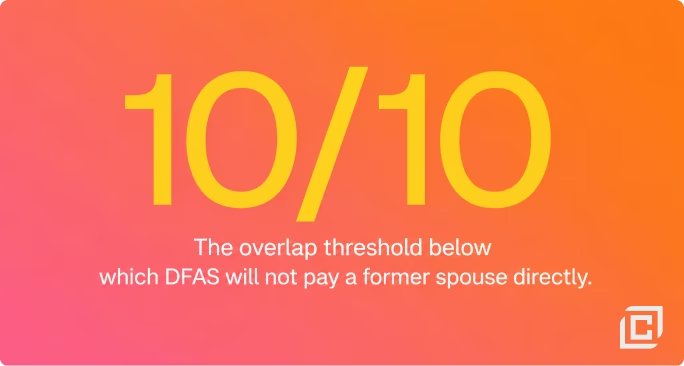
Drafting Military Pension Division When 10/10 Is Not Met

Prepared by Clearwater Divorce Advisors - divorce financial analysis for family-law counsel. Educational material for family-law professionals; not legal, tax, or health-plan advice.
Download PDF
Federal Eligibility · Final-Decree Timing
CHCBP · Reserve Component Traps
Adam Waitkevich
President and Founder

Bottom Line

When the 10/10 requirement isn’t met, DFAS cannot pay a former spouse directly to enforce a division of military retired pay as property. (Support garnishments are different.) The award can still be valid and enforceable against the member — but every enforcement mechanism DFAS normally provides now has to be built into the order itself. The decree either does that work or it doesn’t.

What changes when 10/10 isn’t met
Key drafting considerations

What changes when 10/10 isn’t met

WHAT DFAS NORMALLY DOES FOR YOU WHAT YOU NOW HAVE TO BUILD INTO THE ORDER
Cuts a monthly check to the former spouse DFAS makes no direct property payment to the former spouse — the order must set the remittance terms
Applies proportional COLAs to a percentage award Fixed-dollar awards get no COLA — the order must say how COLAs affect what's remitted
Withholds tax on the former spouse’s portion The full amount generally lands on the member’s 1099-R — tax allocation and reporting must be addressed
Issues a 1099-R to each party Generally only the member gets a 1099-R — reporting gets messy
Verifies the calculation against payroll records Former spouse has no built-in verification right unless the order provides one

Key drafting considerations

1

SBP eligibility doesn’t depend on 10/10.

10/10 controls how retired pay is paid; the Survivor Benefit Plan has its own eligibility, election, and filing rules. A court can order former-spouse coverage. The member’s election generally must be received within one year of the divorce — and if the member fails or refuses, the former spouse’s “deemed election” request generally must be received within one year of the court order requiring coverage. Miss both windows and coverage is usually lost; correction-board relief exists but is not guaranteed. If the parties decline SBP, any life-insurance replacement should spell out the amount, duration, ownership, beneficiary, premium responsibility, proof of coverage, and lapse remedies — private insurance is not automatically equivalent to SBP.

2

Build in the former spouse’s right to verify the calculation.

In a 10/10 case, DFAS calculates the former spouse’s share from the member’s payroll records. In a non-10/10 case, the member generally becomes responsible for calculating and remitting the payment — and the former spouse may never see the pay data behind the number. If the decree doesn’t give the former spouse an express right to retirement and pay records, the right to have the calculation verified, and advance notice before the member retires, the client is trusting the member’s math for the rest of both their lives.

3

Establish the tax-coordination process before payments begin

When DFAS pays a former spouse directly, it issues the former spouse a separate 1099-R and applies federal withholding rules to that payment. When 10/10 isn’t met, the retired pay is generally paid and reported to the member, who then remits — and the right way to reconcile the tax is fact-specific. The drafting point is to set the process now: the intended after-tax allocation, who performs the year-end true-up, how a neutral tax professional will be selected when needed, how disputes get resolved, and who bears the cost. A clause that says only “parties shall consult a CPA” is where these reconciliations stall.

4

The order must supply the payment and enforcement mechanics.

In a 10/10 case, DFAS is in the loop — if DFAS rejects the order or requests clarification, counsel may be able to obtain and resubmit a clarifying order. In a non-10/10 case, payment runs through the member personally, and the remedies for nonpayment come from state law, not DFAS. If the agreement is silent on an issue, that issue is likely to be litigated — or lost. Build in: direct-payment mechanics, notice of retirement, records access, COLA treatment, tax coordination, SBP election (or replacement), survivor protection, dispute resolution, and a retention-of-jurisdiction provision allowing the court to enforce or clarify the award to the extent state and federal law allow. Thin drafting here is how former spouses lose benefits years later.

Primary sources reviewed

Get future attorney briefings by email.
Get notified when new briefings are published.
Thank you! Your submission has been received!
Oops! Something went wrong while submitting the form.
Written for counsel — no consumer marketing, ever.
Working a live case that needs hands-on financial analysis?
Services for attorneys